Natural Language Camera Movement Understanding

Yuwen Tan1 · Joey Huang1 · Jin Huang2 · Haoxiang Li2 · Boqing Gong1

1Boston University    2Pixocial Technology

ECCV 2026

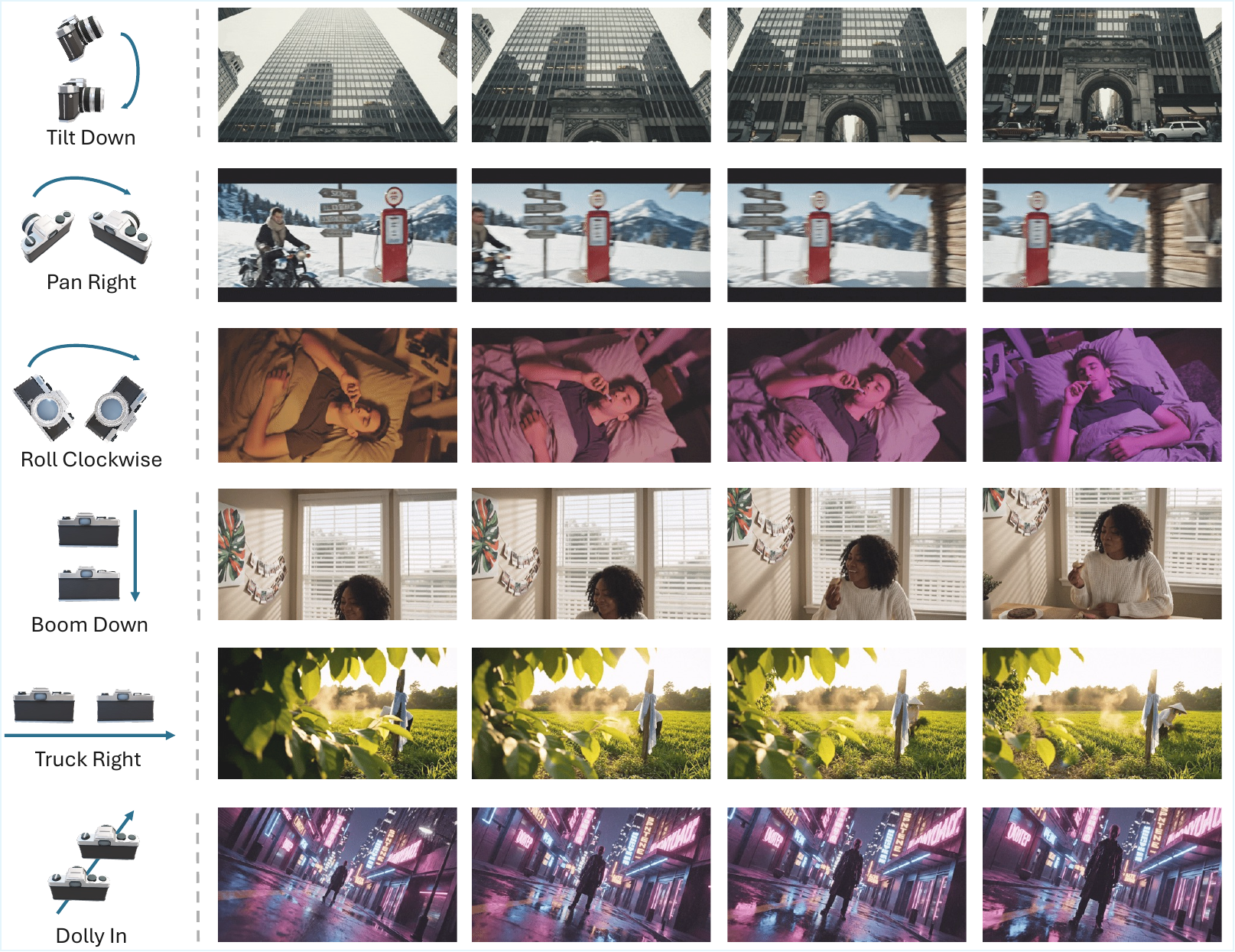
Examples of camera movements in cinematographic practice: rotations (pan, tilt, roll) and translations (boom, dolly, truck).

Examples of camera movements in cinematographic practice: rotations (pan, tilt, roll) and translations (boom, dolly, truck).

We introduce ACaM, an extensive benchmark and instruction-tuning framework for evaluating whether vision-language models (VLMs) can recognize fine-grained, atomic camera movements in real-world and synthetic videos. Existing VLMs fail this task in surprising ways — confusing translation with rotation, left with right, optical zoom with physical dolly, and object motion with camera motion. Our fine-tuned VLM-8B outperforms Gemini 3.1 Pro by 10% on real and 11% on synthetic videos, while a substantial gap to human performance remains.

Abstract

Understanding camera movement in natural language is critical for training and evaluating video generation models, among other applications. However, we demonstrate that existing vision-language models (VLMs) fail this task in surprising ways, frequently confusing translation with rotation, left with right, and object movement with camera movement. To address these limitations, we establish natural language camera movement understanding as a standalone research task. We introduce a two-level cinematographic taxonomy and an extensive, atomic benchmark featuring both real and synthetic videos. Furthermore, we curate a large-scale, multi-source training set enhanced by targeted camera movement augmentation. Our fine-tuned VLM-8B outperforms Gemini 3.1 Pro by 10% and 11% on our benchmark's real and synthetic videos, respectively. Despite these gains, a significant gap remains relative to human performance, underscoring the need to promote and facilitate future research on natural language camera movement understanding.

A Two-Level Cinematographic Taxonomy

Drawing on established cinematography literature, we organize camera movement into a two-level taxonomy of 17 fine-grained classes, spanning physical translations, angular rotations, focal-length changes, static shots, and object-centric movements.

Group Camera Movement Class
Translation Dolly InMove in, Push in, Move forward Dolly OutMove out, Pull out, Move backward
Truck LeftMove to the left Truck RightMove to the right
Boom UpPedestal up, Crane up, Move upwards Boom DownPedestal down, Crane down, Move downwards
Rotation Pan Left Pan Right
Tilt Up Tilt Down
Roll Counterclockwise Roll Clockwise
Focal Length Zoom In Zoom Out
Static StaticStationary, Fixed, No movement
Object-centric Movement TrackingFollow shot ArcOrbit

Taxonomy of camera movements with cinematographic terminology and common aliases.

Why Is Camera Movement Understanding Hard for VLMs?

Through preliminary evaluations, we find that VLMs' deficiencies fall under five recurring failure modes. They are insensitive to subtle inter-frame change, confuse physical translation with angular rotation, frequently misinterpret movement direction, struggle to distinguish optical zoom from physical dolly, and conflate object movement with global camera movement.

1. Small movement insensitivity

VLMs misclassify dynamic shots as static, especially under small, low-intensity motion that humans easily detect.

2. Translation ↔ Rotation confusion

Models rely on superficial 2D shifts and confuse a lateral translation (truck) with an angular rotation (pan), and vice versa.

3. Left ↔ Right confusion

Even strong models predict the opposite direction within the same movement category, visible as off-diagonal mass in confusion matrices.

4. Optical Zoom vs. Physical Dolly

Models fail to use parallax cues and misclassify focal-length changes as physical translation, or vice versa.

5. Object motion vs. Camera motion

VLMs follow salient foreground subjects rather than global background cues, mistaking object motion for camera ego-motion.

ACaM: An Atomic Camera Movement Benchmark

ACaM compiles an extensive, atomic benchmark covering both real-world cinematography and synthetic videos. We purposely choose atomic camera movements — one and only one dominant movement per video clip — leaving compound movement combinations for future work.

Real-world videos

We unify several existing motion understanding benchmarks (CameraBench, ShotBench, CineTechBench, MotionBench, FavorBench) and apply tailored filtering to retain single-movement clips. We further enrich underrepresented classes with curated YouTube videos. The assembled benchmark is manually verified by graduate students with cinematography training.

Synthetic videos

ACaM also includes AI-generated videos that mimic the automatic rating of generative models. We feed real-world videos and target movement labels to Gemini 3 Pro to produce structured generation prompts, then pass them to Veo 3.1 for synthesis. Each clip is manually quality-controlled and re-prompted in iterative passes.
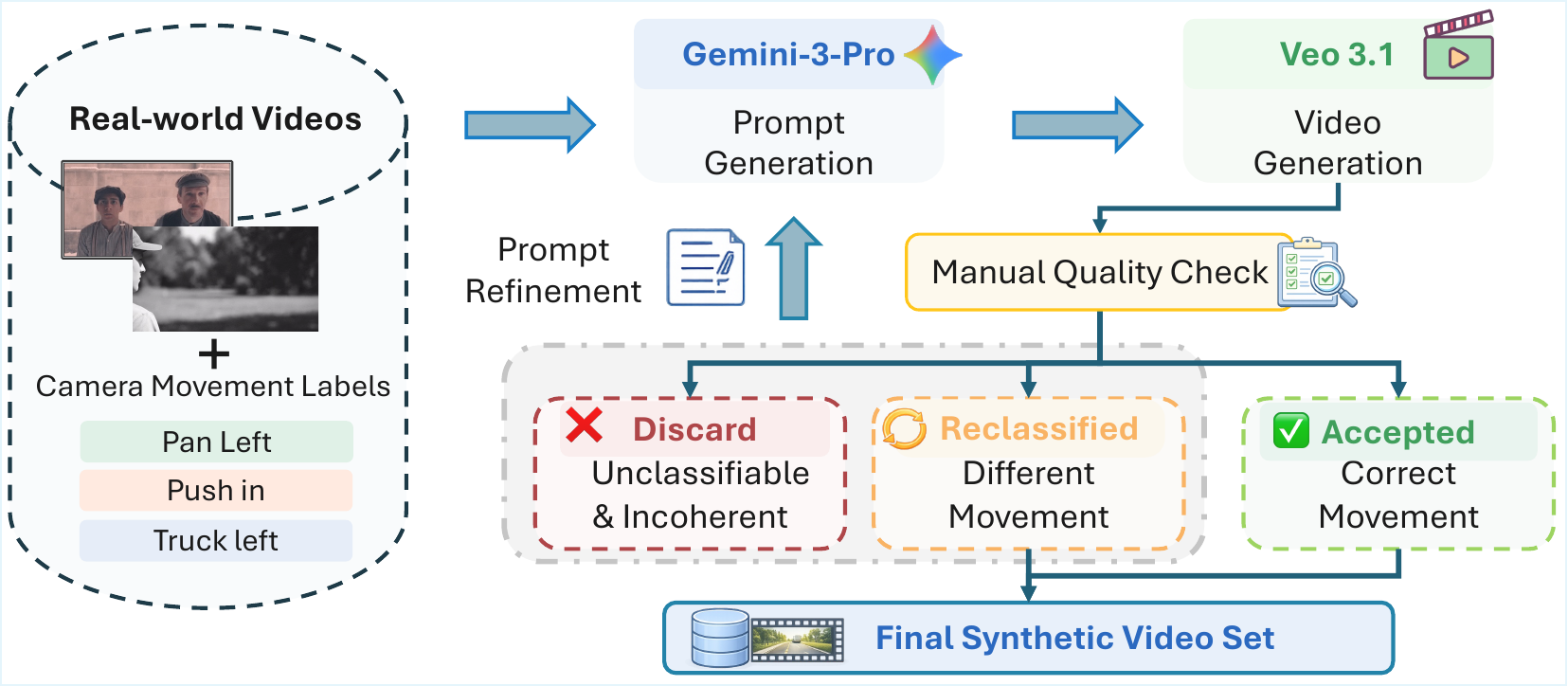
Pipeline for generating synthetic videos of various camera movement classes.

Pipeline for generating synthetic videos for each camera movement class, using Veo 3.1.

Dataset statistics
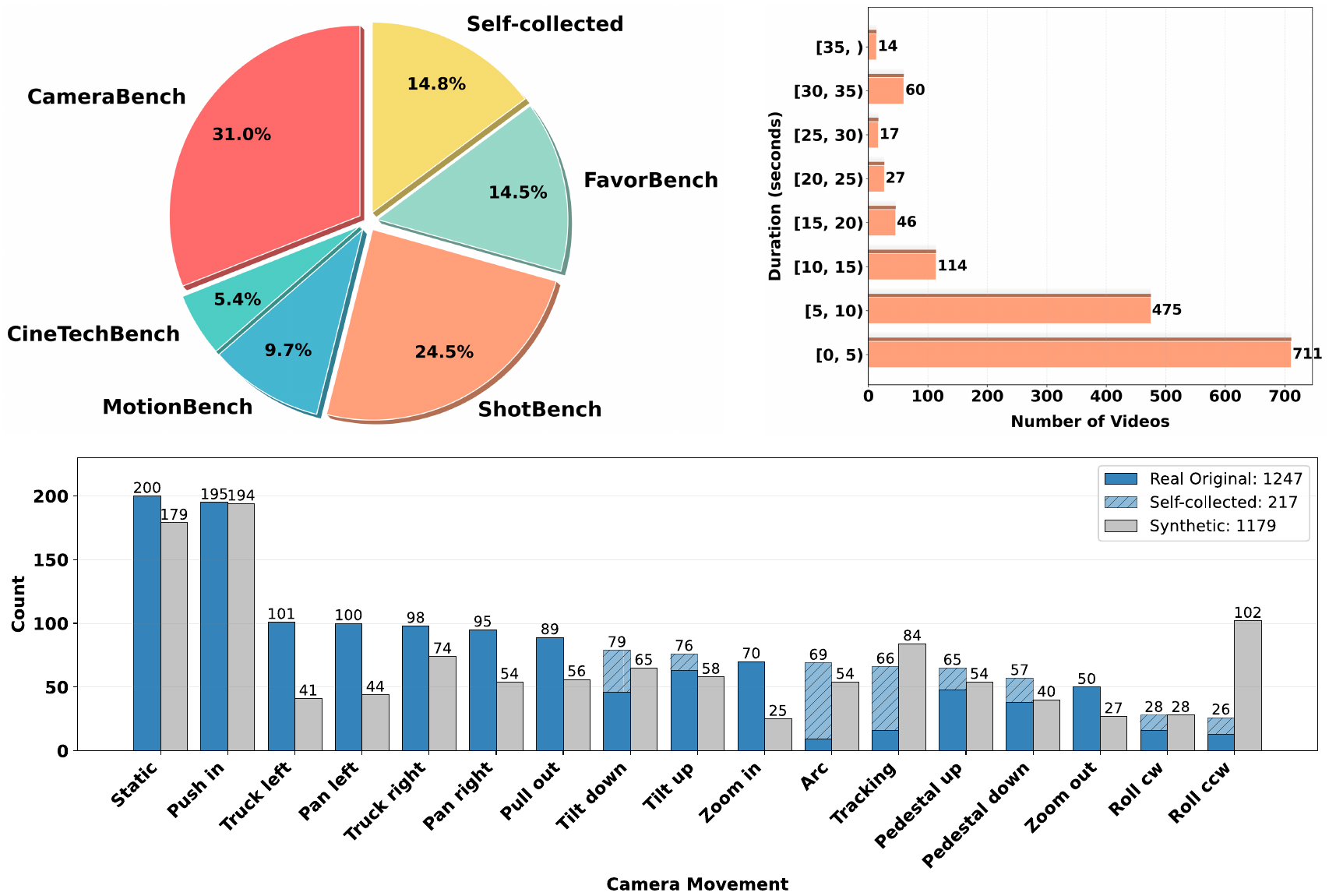
Dataset statistics of the ACaM evaluation benchmark.

Dataset statistics of ACaM. Top: source composition and duration distribution of real-world videos. Bottom: class-wise distribution of real-world and synthetic videos.

Comparison with existing benchmarks

Benchmark Real Syn #Train #Test Yes/No MCQ Human #Labels
Cinematic2K1,04711
CameraBench1,4021,07150
ShotBench-Subset1,05846417
CinetechBench-Subset12015
MotionBench-Subset5,000385
FavorBench-Subset17,000546
ACaM (Ours)24,3212,60217

Comparison with prior camera-movement understanding benchmarks. ACaM is the first to include synthetic videos and human performance.
Training: Multi-Source Data with Targeted Augmentation

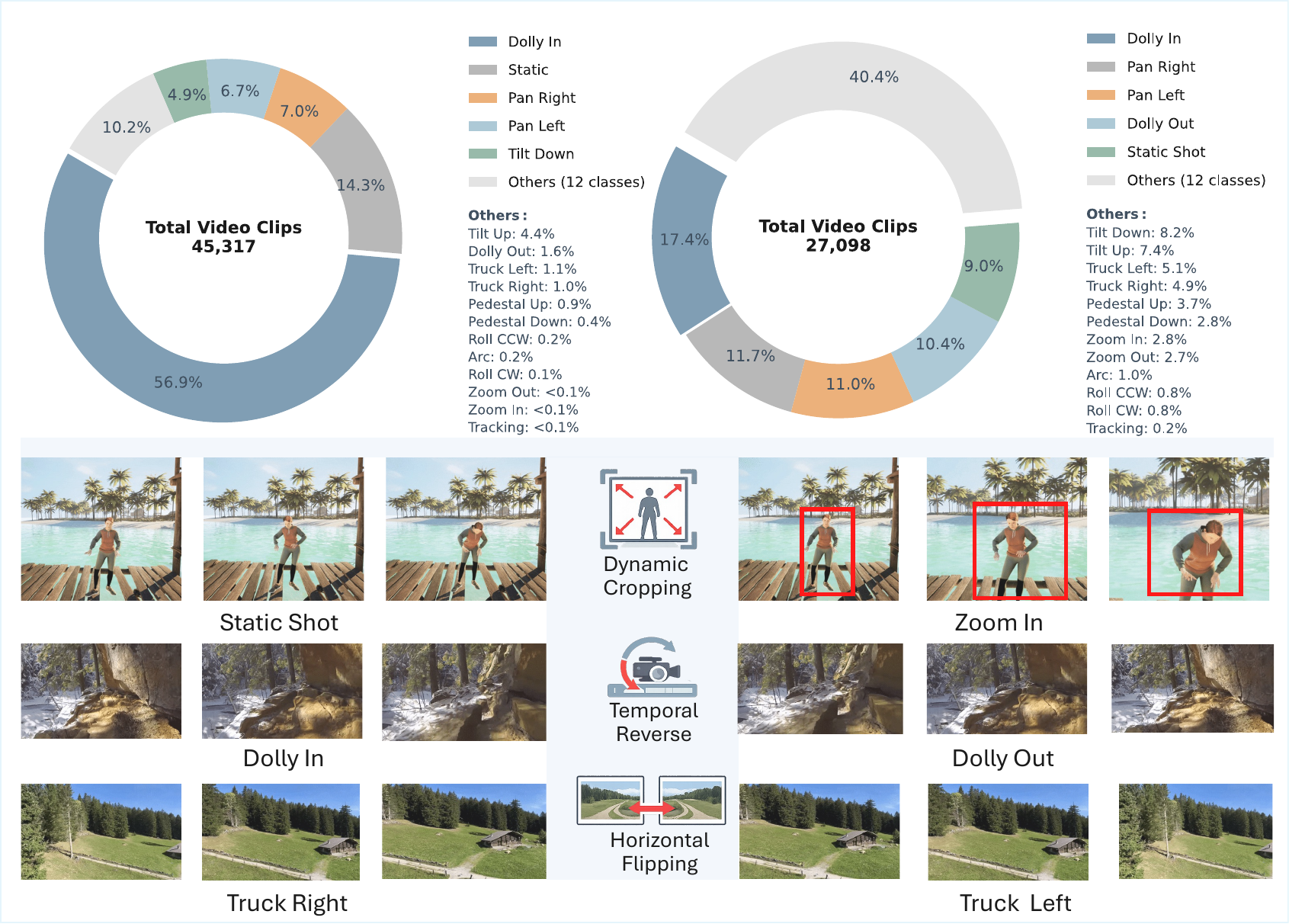
We construct an instruction-tuning set of 27K samples, drawn from 45K raw clips spanning five sources: CameraBench, ShotBench, SpatialVID, MultiCamVideo, and GenDoP. We re-balance the long-tailed distribution with class-aware re-sampling and targeted augmentation.

Sources

Dataset #Extracted Clips Annotation Label Source #Labels
CameraBench723Motion captionHuman annotation16
ShotBench375MCQ formatHuman annotation14
SpatialVID29,733Movement labelsEstimated poses12
MultiCamVideo12,048Camera poseSynthetic trajectory13
GenDoP2,438Movement captionEstimated poses6
Overall45,317MCQ formatMixed17

Targeted augmentation for distribution balancing

Targeted data augmentation for distribution balancing.

Top: shift from an unbalanced 45K raw set to a refined 27K instruction-tuning set. Bottom: per-class augmentation operators — progressive cropping for zoom, temporal reversal for dolly, horizontal flipping for truck, and continuous affine rotation for roll.

Results

We supervised fine-tune Qwen3-VL-4B and 8B on our training set and compare to geometry-based models, spatial VLMs, general VLMs (open-source and proprietary), and prior camera-movement specialized VLMs. Numbers below are accuracy (%).

Real-world videos

Model Static Rot. Trans. Zoom Arc Track Overall Avg
Random Guess24.5024.2824.0024.5424.7825.0024.2724.37
Human99.0093.0790.3990.8397.1096.9793.4493.14
Visual Geometry Models
Mega-SaM89.5574.9454.16
ViPE61.8149.7173.17
Spatial VLMs
G²VLM-2B9.504.524.527.445.717.585.665.24
Spatial-MLLM59.0016.9831.7241.6724.2977.2734.2229.68
VLM-3R-7B94.5020.6928.5535.8351.4389.3940.2235.02
General VLMs
Qwen3-VL-4B93.5053.4734.2161.6756.5280.3053.0146.96
Qwen2.5-VL-7B81.0033.9134.7158.3366.6792.4246.8645.62
Qwen3-VL-8B85.0065.8439.5061.6779.7174.2458.2755.25
LLaVa-OV-7B92.5028.7125.7924.1762.3275.7639.5534.85
InternVideo2.5-8B82.5031.4428.4364.1750.7292.4243.5141.07
InternVL3.5-8B89.0048.5130.5858.3340.5886.3648.7746.15
InternVL3.5-14B81.0043.5639.8363.3355.0789.3951.3747.21
Qwen3-VL-32B92.0064.1147.9364.1757.9786.3661.9558.66
GPT-561.5066.5854.5561.6768.1280.3061.2061.54
Gemini-3-Pro83.5064.3660.8465.0082.6196.9768.2466.83
Gemini-3.1-Pro83.9263.3464.0062.3976.8195.3868.4467.73
Camera Movement Specialized VLMs
CameraModel-7B55.5068.8147.9345.8391.3098.4858.8860.56
ShotVL-7B91.0060.4051.0732.5068.1298.4860.5257.09
CamReasoner-7B76.5041.5832.8959.1739.1380.3045.8344.99
SFT Qwen3-VL-4B (Ours)76.0071.5364.1376.6778.2693.9470.8372.27
SFT Qwen3-VL-8B (Ours)85.5070.0564.1384.1784.0696.9772.7574.28

Synthetic videos

Model Static Rot. Trans. Zoom Arc Track Overall Avg
Random Guess25.0025.0025.0025.0025.0025.0025.0025.00
Human98.8897.7298.0496.15100.0097.6298.0597.61
Visual Geometry Models
Mega-SaM95.5376.3561.66
ViPE68.1652.4278.65
Spatial VLMs
G²VLM-2B4.442.916.991.925.4513.105.544.51
Spatial-MLLM68.3329.6527.0750.0043.6494.0540.7536.04
VLM-3R-7B99.4418.9043.4551.9247.2789.2948.6838.94
General VLMs
Qwen3-VL-4B97.7754.4242.9273.0840.7472.6258.0253.68
Qwen2.5-VL-7B91.0652.9950.5482.6961.1194.0562.4358.50
Qwen3-VL-8B90.5062.3945.1080.7755.5683.3361.9260.91
LLaVa-OV-7B96.0939.6037.2536.5451.8586.9051.0641.59
InternVideo2.5-8B94.9744.7331.1575.0027.7891.6750.9846.71
InternVL3.5-8B96.0947.2933.9967.3135.1973.8151.7447.73
InternVL3.5-14B88.2741.6047.9376.9231.4886.9055.4751.15
Qwen3-VL-32B91.6268.9555.7782.6951.8567.8667.0164.17
GPT-564.8069.8057.9582.6953.7063.1063.7865.09
Gemini-3-Pro89.9461.5468.6373.0853.7088.1070.6566.27
Gemini-3.1-Pro92.0762.0074.0769.2355.5685.3773.0169.58
Camera Movement Specialized VLMs
CameraModel-7B58.1062.6851.6371.1588.8998.8161.8368.45
ShotVL-7B96.0969.8063.6263.4629.6398.8171.3364.49
CamReasoner-7B84.9251.2842.7067.3155.5677.3855.8153.74
SFT Qwen3-VL-4B (Ours)82.6874.3666.6778.8568.5284.5273.2874.40
SFT Qwen3-VL-8B (Ours)94.4172.3674.5182.6968.5291.6778.2077.44

Ablation: data sampling, augmentation, and LoRA rank

Sampling Augmentation LoRA Model Real (Avg) Syn (Avg)
r=644B48.4258.56
r=644B63.7872.07
r=644B70.8875.03
r=1284B71.8875.20
r=2564B72.2774.40
r=2568B74.2977.44

Combining targeted sampling and augmentation lifts synthetic-video accuracy from 58.56% to 75.03%. The 8B model with r=256 yields the best overall result.

Key takeaways

SFT > Specialized 7B

Our SFT Qwen3-VL-4B beats prior camera-movement specialized 7B models by 9–19% on both real and synthetic videos.

SFT 8B > Gemini-3.1-Pro

Our 8B model outperforms Gemini-3.1-Pro by 10% (real) and 11% (synthetic) overall accuracy.

Gap to humans persists

Even the strongest model trails human performance by ~20%, leaving headroom for future research.

BibTeX

@inproceedings{tan2026acam,
  title     = {Natural Language Camera Movement Understanding},
  author    = {Tan, Yuwen and Huang, Joey and Huang, Jin and Li, Haoxiang and Gong, Boqing},
  booktitle = {European Conference on Computer Vision (ECCV)},
  year      = {2026}
}